
Teller County Wanted Source
There is no Teller County warrant portal. The sheriff's office keeps no wanted page either. That means no county-level count, update schedule, or photo policy exists to describe, and searching the county website tells you nothing about whether a warrant is out. It only proves the sheriff provides no such public tool.
What the Teller County Sheriff's Office does instead is point visitors to Pikes Peak Area Crime Stoppers, a nonprofit serving both El Paso and Teller Counties. Its regional wanted material may feature people tied to either county, and the program itself cautions that entries can be dated or that a warrant may already be inactive. Treat it as a lead. It is not a sheriff's warrant database.
That distinction matters. Regional listings appear when investigators want the public's help, while plenty of active warrants never get that promotion. The list also can't answer a name-specific warrant check. For that, go straight to TCSO or the Teller County court.
Teller County Wanted Listing Fields
A Crime Stoppers entry mixes whatever details help the public spot someone and send a tip. Fields vary. Photos, ages, aliases, charges. One listing may carry all of them; another, almost none. Nothing on the site promises an entry is current. So weigh the dates and the source's own wording before you draw any conclusion from it.
| Field | What it may show |
|---|---|
| Photograph | An agency-supplied or case-related image used for identification. |
| Name or alias | The identity attached to the regional notice, including another name when supplied. |
| Alleged offense | The stated warrant or charge basis at the time the notice was prepared. |
| Narrative | A brief account of why investigators seek information or assistance. |
| Physical descriptors | Details used to help distinguish the named person from someone with a similar name. |
| Reward information | Whether a qualifying anonymous tip may be eligible for a reward under program rules. |
| Tip instructions | The approved phone or online channel for giving information without approaching anyone. |
When a photo appears, view it on the regional site rather than in any copied gallery. Open the original. Read its current language too. Then let the agency or court that controls the warrant confirm actual status.
Note: A person missing from the regional list may still have an active Teller County warrant, so treat absence as no answer at all.
Browse Teller County Wanted Listings
Browsing a wanted list serves two purposes: recognizing a public notice and sending useful facts to the proper channel. It is no substitute for an official warrant check. It also grants no authority to confront, follow, or restrain anyone. That job belongs entirely to law enforcement.
- Open the sheriff-linked Pikes Peak Area Crime Stoppers wanted material.
- Confirm that the entry relates to Teller County rather than another place in the regional service area.
- Read the name, alias, descriptors, alleged offense, date, and source warning together.
- Do not download or republish the photograph as if it were a current official finding.
- Report a current location or safety fact through Crime Stoppers or the TCSO tip channel.
- Call 911 only when there is an immediate danger or emergency.
One possible outcome of a good tip is a booking at the local jail. When that happens, the person may show up in the Teller County roster and booking-record guide. A roster entry confirms physical custody at that moment. That much is solid. What it can't tell you is whether the regional listing actually drove the arrest.
Report Teller County Wanted Tips
Crime Stoppers takes anonymous tips for the wider region. Callers never give a name. A tip can earn a cash reward of up to $1,000. The program's own rules govern eligibility and payment, though, so treat any reward as a possibility rather than a promise.
Pikes Peak Area Crime Stoppers
Colorado Springs: 719-634-STOP (719-634-7867)
Pueblo: 719-542-STOP (719-542-7867)
Online tips: Crime Stoppers tip route
Regional, nonprofit, and linked by TCSO
TCSO maintains a separate official route. Its Crime Tip Form and anonymous voicemail instructions send information to investigations. The sheriff's main and non-emergency number is 719-687-9652, with an anonymous voicemail choice described on the page. Contact fields on the online form are optional.
The project manifest provides a successful capture of the official TCSO crime-tip page.
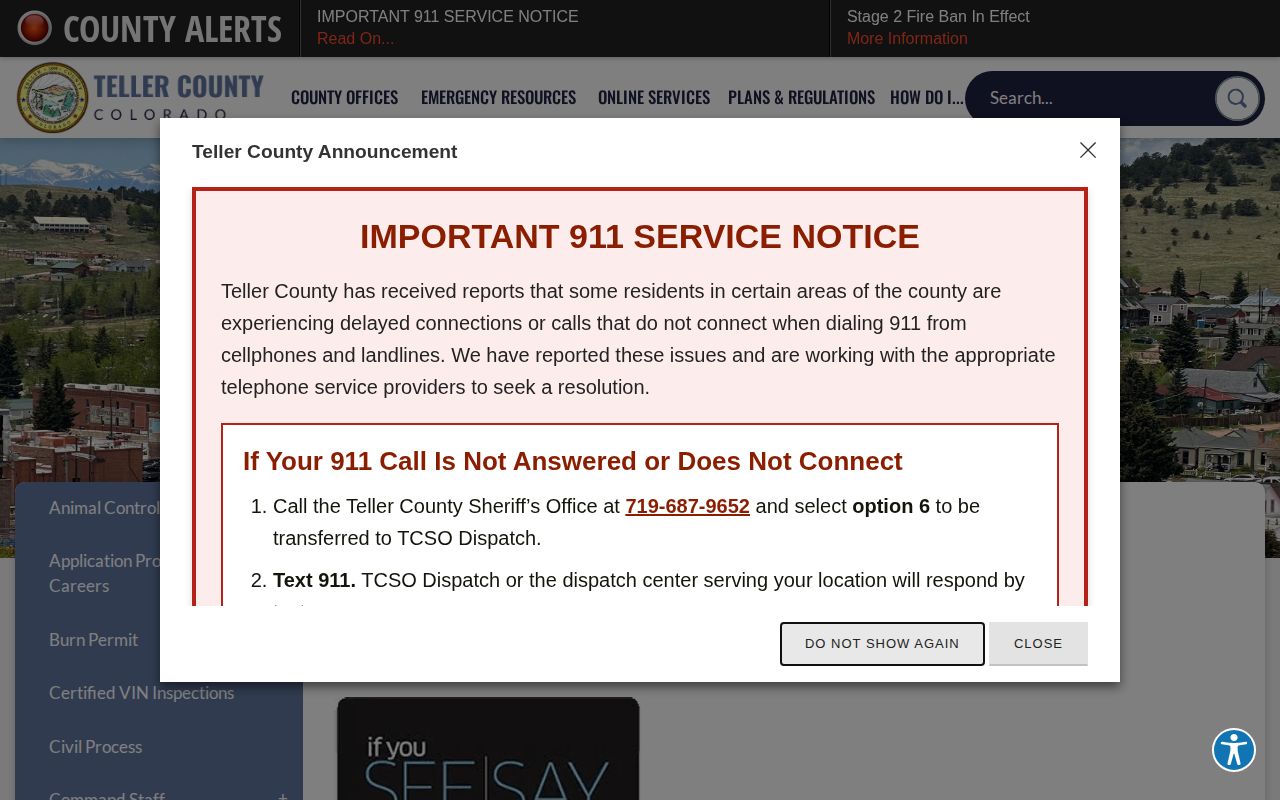
The county's own tip channel handles Teller-specific leads, while wanted photographs remain on the sites of the agencies that publish them.
Safety: Do not approach, track, threaten, or try to arrest a wanted person. Send observations to law enforcement and use 911 for immediate danger.
Check Teller County Warrants
A warrant check starts with identity, not a wanted list. Gather the full name first. Add the date of birth. A known Teller County court case number sharpens the inquiry further. Watch out for near-identical names as well, and remember that broad public pages can sit stale for a long time.
- Call TCSO at 719-687-9652 and ask how to verify warrant information for the named person.
- Use the TCSO records request form for a focused warrant-information request when directed.
- If a case number is known, use the Colorado Judicial docket finder to locate Teller County hearing activity.
- Contact the Teller County Court in the Fourth Judicial District for the official case record or disposition.
- If the warrant may concern the person making the inquiry, work through an attorney or the court to arrange a lawful response.
The public docket finder is flexible. You can search by county, courthouse, court type, division, date, case number, party, or attorney. It surfaces schedules and docket activity. Not every case document opens to direct online viewing, though; the Judicial Branch keeps some closed. For a fuller history, request the register of actions, complaint, disposition, or sentence order directly.
No separate online TCSO warrants-unit search exists. Nor is there a dedicated warrants-unit phone line. The documented official fallback is the sheriff's main and non-emergency number. On the court side, the Teller County Courthouse can route a case-file request. Court staff can't replace legal counsel, and the docket screen alone won't show every document.
Teller County Courthouse
101 W Bennett Avenue
PO Box 997, Cripple Creek, CO 80813
719-689-7360
Monday through Friday, 8 a.m. to 4 p.m.
A court records request can pull several paper types. Think criminal complaints, registers of actions, dispositions, or sentence orders. The stated turnaround is three business days absent unusual circumstances. That clock covers paperwork only. It is no promise that a warrant stays frozen while your request moves through the queue. Questions about safety or surrender go to counsel, the court, or TCSO.
Note: Neither Crime Stoppers nor any social media post replaces direct confirmation from TCSO or the court handling the case.
Teller County Warrant Types
Teller County's public sources skip the tidy glossary. No page lists warrant types with clean legal labels. The clues sit scattered instead. One document may hint at a bench matter. A wanted page might suggest something more serious. The table below gathers those documented signs and sorts them by where each one surfaces. Nothing beyond that gets a legal category here.
| Warrant clue | How to verify it |
|---|---|
| Warrant tied to a court case | Use the case number with the Teller County court, then request the register of actions or relevant order. |
| Warrant named in a TCSO Crime Report | Read the dated report as incident-stage information, then confirm current status with TCSO or the court. |
| Regional wanted notice | Treat it as a selected Crime Stoppers appeal and verify the warrant with the responsible agency. |
| Outside-agency custody basis | Check the named arresting or holding agency because Teller's detention facility can hold federal or other-agency detainees. |
Here's a trap worth knowing. A warrant can sit active with no wanted notice anywhere online. The flip side happens too. An old fugitive page can linger after the underlying warrant has changed or been resolved. That's why three pieces belong together: the source date, the court file, and direct confirmation from the agency holding the warrant.
Resolve Teller County Warrants Safely
Think a Teller County warrant carries your name? Don't trust a silent search page. Reach out to a lawyer, the Teller County court, or TCSO for the proper steps. Dodging service or racing an arrest only stacks on more risk.
The paper trail splits after an arrest on a warrant. The jail opens a booking entry and takes an intake photo. Then the court takes over. It handles hearings, charging decisions, pleas, dismissals, trial results, and sentencing. Keep one thing straight, though. Walking out of the Teller County Detention Facility closes nothing. A release is just a release.
A move to state prison changes the custody picture. For that, the Colorado Department of Corrections Offender Search is the source that matters. CDOC tracks sentenced state offenders. It won't show a fresh Teller County booking or an unconfirmed warrant.
TCSO runs Facebook, X, Instagram, and YouTube accounts. The content there is event-driven, not systematic. No official Teller County "Warrant Wednesday" series exists. No inmate or warrant app was found either. Peak Alerts handles emergency and location-based notices, not warrant lookups. Treat those channels as alerts. Then return to TCSO and court records for the current facts.
Someone held in Teller County isn't always there for Teller County. The detention facility fills an ICE role. Jail profiles can list a U.S. Marshals Service hold or another federal hold. Check the arresting-agency and primary-offense fields first. Where a person sits, who arrested them, and which court runs the case can point in three different directions.
A local release answers none of the bigger questions. It says nothing about outside holds or future hearings. It won't say whether the underlying case stands or was dismissed. Verify each stage with the office that owns that record. That habit keeps a wanted notice, a jail entry, and a court outcome from blending into one claim.